The Anticapitalism Allegory of No More Heroes
by Joel Jordon
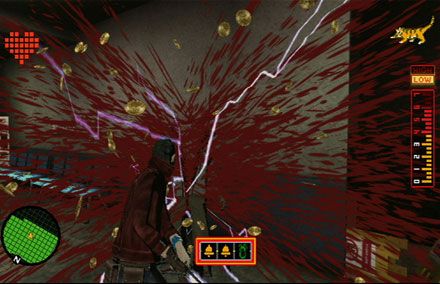
“Whatever happened to Leon Trotsky?
He got an ice pick
That made his ears burn.”
— The Stranglers, “No More Heroes”
No More Heroes is commonly interpreted as a parody and critique of video games, but I think the game has something to say on a whole other level: it also seems to be a critique of the capitalist system. The game’s anticapitalism allegory is apparent in all aspects of its design, including in its narrative, game mechanics, self-aware aesthetics, and the way it portrays its protagonist. I’ve broken this essay into four sections in order to discuss each of these aspects in turn and demonstrate how No More Heroes serves as a rare example of a game whose many parts all work together to express the same message. The cohesiveness of all of the game’s parts allows it to effectively communicate a message to the player that is both political and emotional.
How To Express Conflict in Games: Silicon Sisters Criticizes Male-Dominated Games Industry
by Joel Jordon
 A company called Silicon Sisters Interactive bills itself as a game developer aiming at designing games for females. The company has so far released just one game, School 26, which is about forming relationships in high school. Here’s a quote from the COO (from this article):
“It took 30 years to really perfect the three things that males seem to really love, which are shooting, and driving, and sports,” Forbes said. “And those are absolutely kick-ass games now, and you really have to sit back and go, ‘What is the equivalent for girls? And please God, don’t let it take us 30 years to get to as high a quality level as that.'”
by Joel Jordon

[Since I think some readers are (understandably) getting confused by the title, I’d like to clarify that this article doesn’t actually really deal with the uncanny valley. I meant to use it more as an analogy: the uncanny valley refers to the dissonance we experience when humanoids start to look too realistic, and this article discusses the dissonance players might experience when realistic game graphics are coupled with unrealistic (“gamey”) game mechanics.]
In one scene in Uncharted 2, the player has to fight his or her way across a moving train, all while a lavish jungle and thousands of trees pass by. The train occasionally crosses bridges suspended over lakes, and sometimes, if you look deep into the jungle, you can see little villages made up of a variety of huts. And all of these are background details—it’s pretty hard to focus on any of them because you have to be more concerned with fighting off enemies and not getting killed. At times you’re even inside the train so you can’t actually see any of the jungle, but the developers nonetheless designed it all and it’s all still passing by in real time. The point of making these background environments so detailed seems like it was to create the illusion that you’re actually traveling on a train and passing by unique environments every few seconds.
 The Game Manifesto