By Joel Jordon
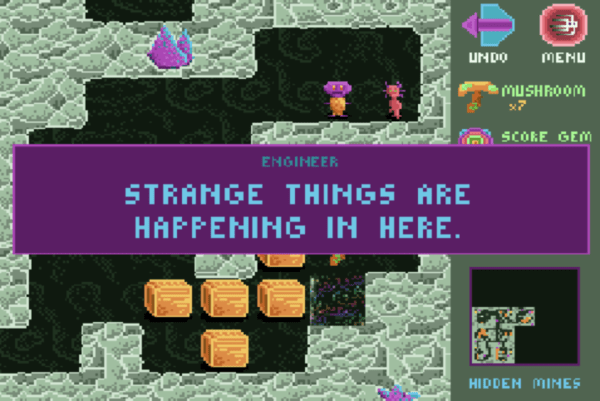
The undo button in Corrypt that allows you to rewind from mistakes made while solving puzzles as many times as necessary is a good replacement for something like the death mechanic used in most games, for which the checkpoints are often arbitrary. Undo is a mechanic that punishes you in a way that’s less noticeable, with the time it takes for you to use it and get back to where you were only adding up if mistakes aren’t dealt with immediately. Leave a box in an unreachable place and go to solve some other puzzles, and you’ll have to use undo until you get all the way back to the time you stupidly left the box like that, resetting all the puzzles you solved. This prepares you for the game’s mechanical twist.
One of a Hundred: The Perspective of an “Outsider” on Indiecade East
By Joel Jordon

It’s great how much you could take for granted at Indiecade East, held this past weekend at the Museum of the Moving Image in New York. You could take for granted that the people there love games and are, overwhelmingly, open-minded about them and want to see new things done with them. The academics there from NYU, Parsons, and elsewhere are all as far away as possible from stodgy academicism. They are grown adults who have dedicated their lives to studying play and designing games, and so it shouldn’t be surprising that they’re all fun and funny in person. You can take for granted that they take for granted the value of games, and while it’s apparent they’re exploring the expressive potential of the medium I also get this sense that they just see the inherent value in bringing play back into other adults’ lives.¹ Groups from NYU and Parsons competed against each other at the iron game design challenge, and the Parsons group designed a physical game in the spirit of Johann Sebastian Joust, the kind of playful social game I mean that everyone here seems to appreciate.
A New Year
By Joel Jordon
My views on videogames have been shifting rapidly recently. In the past year I’ve been leaning away from the idea that narrative should come first in games and more toward the idea that, through engagement with the seemingly formal characteristics of games—their mechanics and rules—through play, a story or feeling can emerge. But I also understand that it’s problematic to define the essential characteristics of a medium like that because it can be exclusionary of art that takes other forms. See some of the ongoing debate on this in the comments below these articles: Designing for Grace, Two Cultures and Games, and What Is a Game? It Depends Who’s Playing.
 The Game Manifesto